Cardiac Catheterization
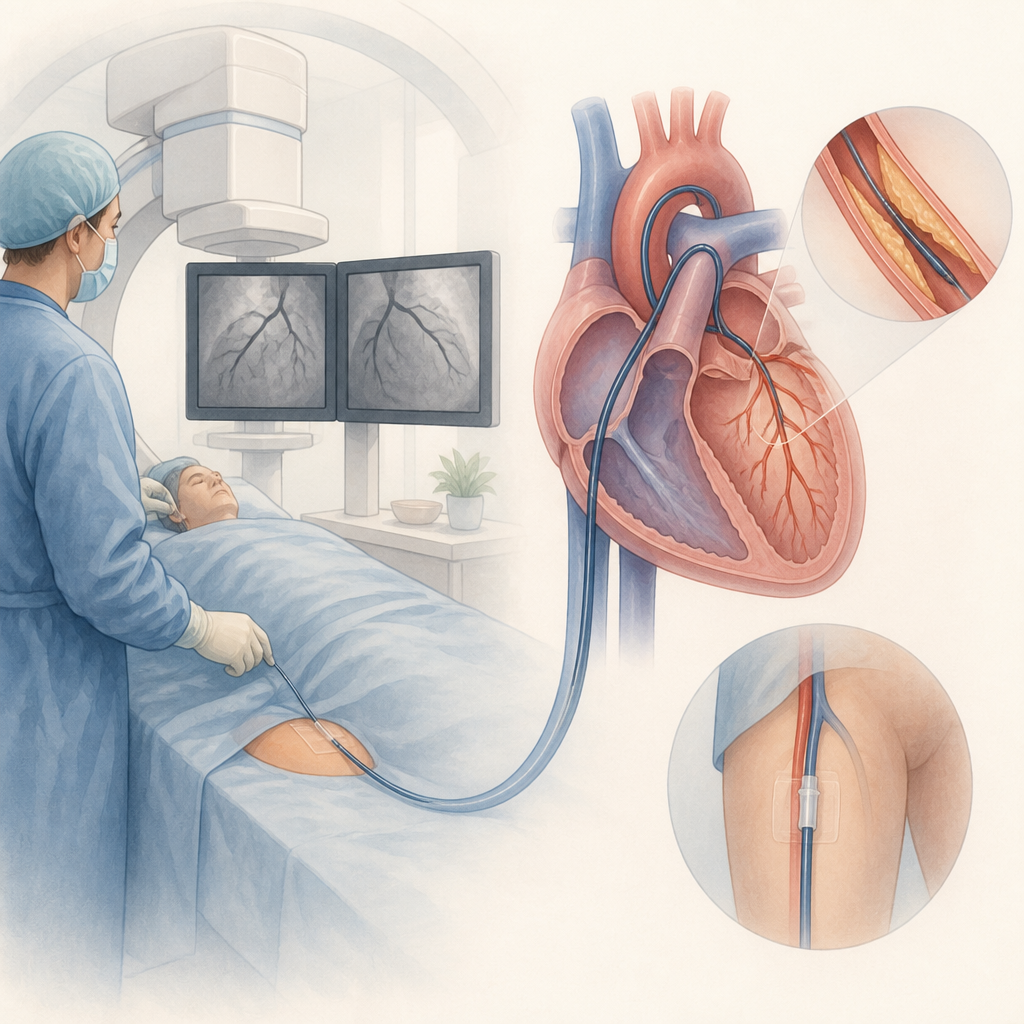
Cardiac catheterization is a diagnostic and interventional procedure where a thin, flexible tube (catheter) is guided through a blood vessel to the heart. It…
- Success rate
- >90%
- Avg cost (US)
- $2,500 - $15,000 (range)
- Recovery
- 1-3 days (typical)
- US volume / yr
- 1,000,000 - 2,000,000 (range)
Browse verified cardiology providers who offer this procedure.
This procedure helps patients with suspected coronary artery disease, heart valve issues, or unexplained chest pain. It is also vital for patients experiencing acute coronary syndromes, such as heart attacks, to restore blood flow to the heart muscle.
You will be awake but sedated for the procedure. A doctor inserts the catheter through an artery, typically in your wrist (radial) or groin (femoral). Using X-ray guidance, they move it to your heart. You might feel a brief flush if contrast dye is used to highlight your arteries on the imaging screen.
After the procedure, you will stay in a recovery room for a few hours for monitoring. Your length of stay depends on whether the catheterization was strictly diagnostic or included a treatment like a stent. Most patients can return to normal activities within a short timeframe, though you will need to avoid heavy lifting for several days.
Pricing varies significantly based on geographic location, insurance coverage, and whether an intervention (like a stent) is performed alongside the diagnostic test.
Questions to ask your doctor
- Will you be using my wrist or my groin for the catheter insertion point?
- Do you plan to perform an intervention, such as a stent, if you find a blockage?
- What are the specific risks for someone with my health history?
- When can I return to work and resume physical exercise?
- What medications will I need to take following the procedure?
Frequently asked
Approximately 51.9% of patients receive a left heart catheterization, 14.6% receive a right heart catheterization, and 34.5% receive both.
Major complications during a diagnostic cardiac catheterization are rare, occurring in less than 1% of cases.
The radial (wrist) approach has a success rate of over 90% and is preferred by many for comfort, as it rarely requires switching to the groin approach.
Care is provided by a multidisciplinary team including cardiologists, nurses, advanced clinicians, and pharmacists to ensure safety and success.
Deep dive: Cardiac Catheterization: What Patients Should Expect in 2026
Disclaimer: The following information is for educational purposes only and does not constitute medical advice. Always consult with a qualified healthcare professional for medical diagnosis or treatment.
Who it's for
Cardiac catheterization, often referred to as a "cardiac cath," remains the gold standard for diagnosing and treating many heart conditions in 2026. While non-invasive imaging like high-speed CT scans has become incredibly advanced, a cardiac cath is the primary tool used when your doctor needs "live" information about how your heart is functioning or needs to perform an immediate intervention.
This procedure is typically recommended for individuals experiencing:
- Chest Pain (Angina): If you have persistent chest pain that doesn't improve with medication, this test helps map out blockages in the coronary arteries.
- Heart Valve Issues: For patients with leaky or narrowed valves, a catheterization measures the pressure on both sides of the valve to determine if a replacement is necessary.
- Congenital Heart Defects: It is used to visualize structural issues present from birth.
- Heart Failure Symptoms: If you have shortness of breath or fatigue, the procedure can measure how well the heart muscle is pumping.
- Pre-Surgical Clearance: If you are scheduled for a major non-cardiac surgery, your surgeon may request a cath to ensure your heart can handle the stress of the operation.
In 2026, we also see an increase in "preventative caths" for high-risk patients who have shown concerning markers on wearable health devices or AI-driven diagnostic blood tests.
How it works
The thought of a tube entering your heart sounds intimidating, but the process is highly streamlined and rarely requires general anesthesia. Most patients are "awake" but deeply relaxed through conscious sedation.
The procedure begins with a tiny incision, usually in the wrist (radial artery) or the groin (femoral artery). In modern cardiology, the wrist is the preferred site because it allows for faster recovery and less bleeding. A thin, flexible tube called a catheter is then threaded through your blood vessels and guided toward the heart using real-time X-ray imaging called fluoroscopy.
Once the catheter is in place, several things can happen:
- Coronary Angiogram: A special dye is injected through the catheter. This dye shows up on the X-ray, allowing doctors to see exactly where arteries are narrowed or blocked.
- Pressure Readings: The catheter can measure the blood pressure inside the different chambers of the heart.
- Biopsy: If necessary, a tiny sample of heart tissue can be removed for testing.
- Intervention (Angioplasty): If a blockage is found, the doctor may immediately transition from a diagnostic test to a treatment. They can inflate a small balloon to open the artery and place a "stent"—a tiny mesh tube—to keep it open. In 2026, many of these stents are bio-resorbable, meaning they eventually dissolve after the artery has healed.
The entire procedure usually takes between 30 and 90 minutes.
Recovery & timeline
Recovery from a cardiac catheterization is significantly faster than it was a decade ago.
- The First Few Hours: Immediately after the procedure, you will be taken to a recovery room. If the entry site was in your groin, you may need to lie flat for 2 to 6 hours to prevent bleeding. If the entry was in your wrist, you can usually sit up and walk around much sooner.
- Discharge: Most diagnostic catheterizations are outpatient procedures, meaning you go home the same day. If a stent was placed, you might stay overnight for observation.
- The First 48 Hours: You will be advised to avoid heavy lifting or strenuous exercise. You can usually return to light activity and work within two days.
- Long-term: By the end of one week, most patients are back to their full routine. You will likely have a follow-up appointment within 7 to 10 days to check the entry site and discuss the findings.
Cost & insurance
In 2026, the cost of cardiac catheterization varies based on whether it is strictly diagnostic or involves an intervention like a stent. On average, the cost ranges from $5,000 to $20,000 in the United States.
- Insurance Coverage: Most private insurance plans, as well as Medicare and Medicaid, cover cardiac catheterization when it is deemed medically necessary. Because it is often the precursor to life-saving treatment, it is rarely denied if you have symptoms of heart disease.
- Out-of-Pocket Expenses: You will likely be responsible for your deductible and a co-insurance percentage (often 10% to 20%).
- Transparency Tools: Most modern hospitals now provide AI-powered cost estimator tools. Before your procedure, you should request a "Good Faith Estimate," which provides a breakdown of facility fees, physician fees, and anesthesia costs.
Risks & alternatives
While cardiac catheterization is a routine procedure, it is still invasive and carries some risks. These include:
- Bleeding or bruising: The most common complication, usually occurring at the entry site.
- Blood clots: Rarely, a clot can form on the catheter tip.
- Arrhythmias: Irregular heartbeats may occur during the procedure but usually resolve quickly.
- Dye Reaction: Some patients are allergic to the contrast dye used, though modern dyes are much safer than older versions.
Alternatives: If you are at low risk, your doctor may first suggest non-invasive tests:
- Coronary CT Angiography (CCTA): A high-speed X-ray that provides clear images without the need for a catheter.
- Stress Test: Monitoring your heart's performance on a treadmill.
- Cardiac MRI: Provides detailed images of the heart muscle and valves.
However, these alternatives only diagnose the problem; they cannot fix it. If a significant blockage is found on a CT scan, a cardiac cath is still required to place a stent.
How to choose a provider
When choosing a facility for your heart care, consider the following factors:
- Volume and Experience: Look for a "High-Volume Center." Data consistently shows that hospitals and cardiologists who perform the highest number of catheterizations have the lowest complication rates.
- Radial-First Approach: Ask if the center specializes in "transradial" (wrist) access. This approach is generally safer and more comfortable for the patient.
- Integrated Care: Choose a provider that uses a unified digital health record. This ensures that your primary care doctor, your cardiologist, and any emergency providers have instant access to your cath images and results.
- Technology: Ensure the facility uses the latest imaging guidance systems, which reduce radiation exposure for the patient.
If you are experiencing symptoms of heart disease or have been told you need a diagnostic heart procedure, contact us today to schedule a comprehensive consultation with one of our board-certified cardiologists.
Related patient questions
Sources
- Cardiac Catheterization and Outcomes for Elderly Patients ... - PMC
- Cardiac Catheterization Risks and Complications - StatPearls - NCBI
- Cardiac catheterization - Mayo Clinic
- Effectiveness and safety of transradial artery access for cardiac ...
- Acute Coronary Syndrome Catheter Interventions - StatPearls - NCBI
Find a board-certified cardiology provider in your area.
General information only — not medical advice. Always consult a qualified clinician for your specific situation.