Decompression Therapy
Decompression therapy offers a non-surgical way to relieve back and leg pain. Learn about success rates, recovery times, and how this treatment aids disc…
- Success rate
- 86% to 88%
- Avg cost (US)
- 1/10th of surgical cost
- Recovery
- 1-7 days (range)
- US volume / yr
- Data not provided (range)
Browse verified chiropractic providers who offer this procedure.
This therapy is designed for individuals suffering from discogenic back pain, spinal stenosis, and persistent leg pain who are seeking alternatives to traditional surgery.
Patients undergo sessions using specialized equipment designed to offload spinal pressure. While some manufacturers claim high success rates, clinical results vary by study.
Non-surgical decompression typically requires no downtime, whereas minimally invasive surgical options offer significantly shorter recovery times than traditional open procedures.
Non-surgical decompression is highly cost-effective, often costing less than a tenth of the price of surgical intervention.
Questions to ask your doctor
- Is my back pain considered discogenic?
- How does the cost of this therapy compare to surgical alternatives?
- What are the long-term success rates for my specific condition?
- Will this treatment improve my social and physical functioning over the next five years?
- Is a minimally invasive lumbar decompression an option for me?
Frequently asked
Many manufacturers claim an 86% success rate, and some recent studies have cited rates as high as 88%.
Studies show significant improvements in physical function and pain can last up to five years, though social function gains may diminish over time.
Non-surgical decompression is considered a cost-effective alternative, typically costing less than 10% of what a surgical procedure would cost.
Deep dive: Spinal Decompression Therapy: 2026 Guide to Non-Surgical Relief
Disclaimer: This information is for educational purposes only and does not constitute medical advice. Always consult with a qualified healthcare provider for a professional diagnosis and treatment plan.
As we move into 2026, the landscape of non-surgical spinal care has evolved significantly. One treatment that continues to gain momentum for its efficacy and non-invasive nature is Spinal Decompression Therapy. If you are struggling with chronic back pain, radiating leg pain, or neck stiffness that hasn't responded to traditional rest and exercise, understanding this technology is a vital step toward reclaiming your mobility.
Who it's for
Decompression therapy is specifically engineered for individuals suffering from mechanical issues of the spine—essentially, problems where pressure is the primary enemy. In 2026, clinical guidelines have refined exactly who benefits most from this procedure.
The primary candidates are those dealing with "discogenic" pain. This includes herniated, bulging, or protruding discs. When a disc loses its shape, it can press against sensitive spinal nerves, leading to the localized pain of a "slipped disc" or the shooting, electric sensations of sciatica.
It is also a frontline option for patients diagnosed with Degenerative Disc Disease (DDD). As we age, our spinal discs can lose hydration and height, leading to bone-on-bone friction and stiffness. Decompression helps combat this by creating space. Additionally, those with Posterior Facet Syndrome (worn-out spinal joints) or Spinal Stenosis (narrowing of the spinal canal) often find significant relief through this method.
Importantly, it serves as a critical alternative for people who have been told they are candidates for spinal fusion or microdiscectomy but wish to explore conservative options first. It is generally not recommended for those with advanced osteoporosis, spinal fractures, or metal implants in the spine.
How it works
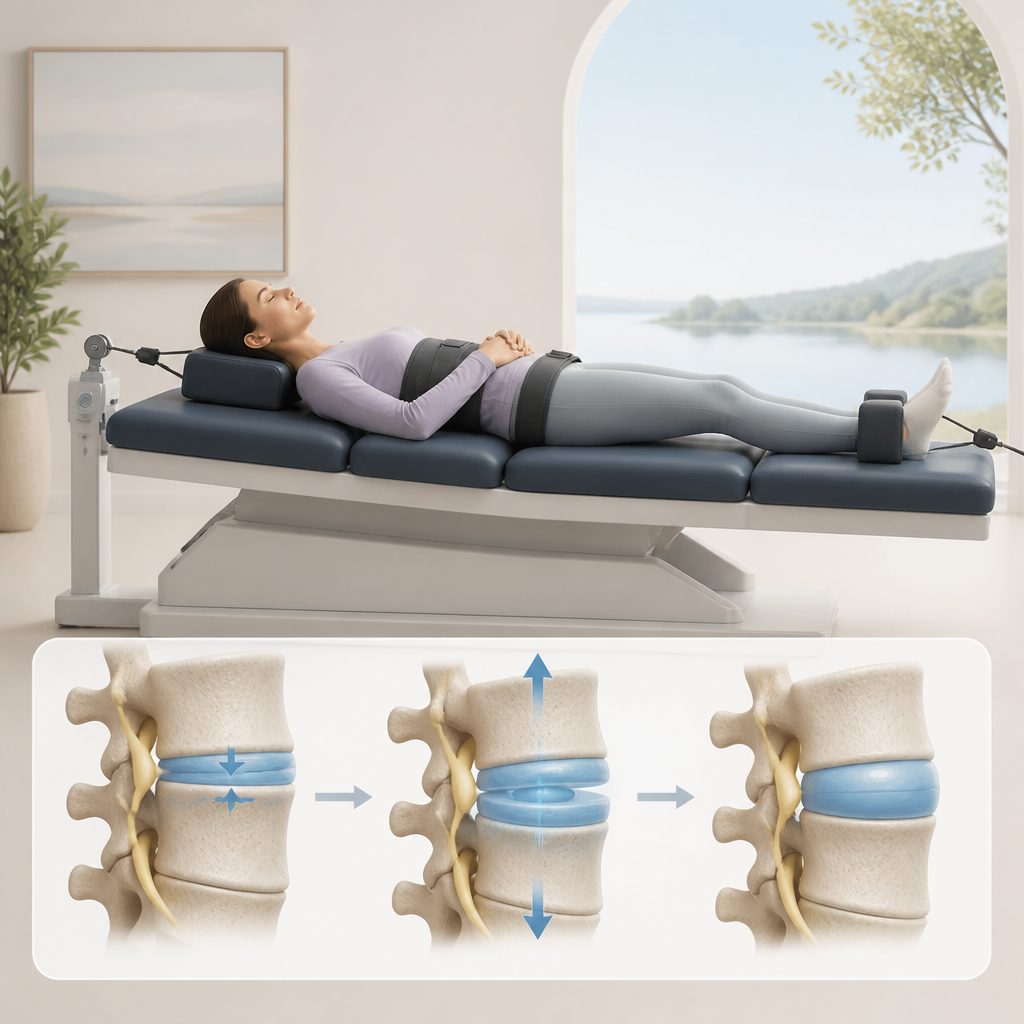
At its core, Spinal Decompression Therapy is a sophisticated, computer-controlled evolution of traditional traction. Unlike older traction methods that pulled the body with a constant force—often triggering the body’s natural muscle guarding reflex—modern decompression uses biofeedback sensors.
These sensors monitor your muscle tension thousands of times per second. If the system detects your muscles tensing up, it automatically adjusts the tension. This allows the spine to be stretched in a "logarithmic" curve, bypassing the body's defensive reflexes to achieve a state of negative pressure within the spinal discs.
Think of it like a vacuum effect. When the vertebrae are gently separated, a "vacuum" is created inside the disc. This serves two purposes:
- Retraction: It helps pull the bulging or herniated disc material back toward the center of the disc, taking pressure off the nerves.
- Rehydration: It draws nutrient-rich fluids, oxygen, and water into the disc. Because discs do not have a direct blood supply, they rely on this "pump" mechanism to heal.
By 2026, many tables have integrated laser therapy or heat elements that work simultaneously with the mechanical pull to further relax the tissues and speed up cellular repair.
Recovery & timeline
Non-surgical decompression is not a "one-and-done" fix; it is a cumulative process. Because we are working with living tissue that has often been compressed for years, the body needs time to adapt to these structural changes.
Most treatment protocols involve 12 to 24 sessions over a period of 6 to 10 weeks.
- Weeks 1-2: The goal is pain reduction. You might feel a "lightness" in your spine or a decrease in the intensity of shooting pains.
- Weeks 3-5: This is the stabilization phase. Your body starts to maintain the increased disc space, and you may notice increased flexibility and the ability to sit or stand for longer periods.
- Weeks 6+: The focus shifts to long-term healing and strengthening.
Recovery is typically "passive-active." You spend 20 to 30 minutes on the table (the passive part), but your chiropractor will likely pair this with specific core-stabilization exercises (the active part). Most patients can return to work immediately after a session, as there is no downtime or anesthesia involved.
Cost & insurance
In 2026, the cost of spinal decompression can vary based on your geographic location and the complexity of your case. On average, a single session ranges from $75 to $200. Most clinics offer "care packages" that reduce the per-visit cost when a full protocol is committed to.
Regarding insurance, the landscape is shifting. While many major carriers still classify decompression under the umbrella of "mechanical traction," more providers are beginning to cover portions of the treatment if it is part of a documented rehabilitative plan to avoid surgery.
Many patients utilize Health Savings Accounts (HSA) or Flexible Spending Accounts (FSA) to pay for treatment with pre-tax dollars. When comparing costs, it is helpful to weigh the price of a full decompression protocol against the out-of-pocket deductibles and lost wages associated with a spinal surgery, which can often be five to ten times higher.
Risks & alternatives
While remarkably safe, decompression therapy is not without minor risks. The most common side effect is a localized muscle soreness, similar to the feeling after a new workout, as the muscles around the spine are stretched in ways they aren't used to.
Alternatives to decompression include:
- Physical Therapy: Focusing purely on movement and strengthening.
- Epidural Steroid Injections: These target inflammation but do not address the mechanical "bulge" or pressure.
- Traditional Chiropractic Adjustments: While great for joint alignment, they may not provide the same "vacuum" effect for a severe disc herniation.
- Surgery: Procedures like a laminectomy or fusion. This is usually considered the last resort when conservative measures fail.
Consulting with your chiropractor is essential to ensure that your bone density and overall health make you a safe candidate for the table.
How to choose a provider
Not all decompression tables—or the clinics that house them—are created equal. When selecting a provider in 2026, look for these three factors:
- Technology: Ensure the clinic uses a true "decompression" table (like a DRX9000 or similar high-end system) rather than a simple traction tilt-table. True decompression tables have the specialized sensors required to bypass muscle guarding.
- Comprehensive Care: A good provider won’t just put you on a machine and leave the room. Choose a clinic that integrates decompression with therapeutic exercise, nutritional support (to aid disc rehydration), and lifestyle coaching.
- Transparent Success Rates: Ask the provider about their clinical outcomes for your specific condition. A reputable chiropractor will be honest about whether you are a "good," "fair," or "poor" candidate based on your imaging (MRI or X-ray).
The goal of 2026 spinal care is to be proactive rather than reactive. If you’re ready to address the root cause of your pain without needles or knives, decompression therapy may be the bridge to your recovery.
If you are tired of living with persistent back or neck pain, contact our office today to schedule a comprehensive evaluation and see if you are a candidate for spinal decompression therapy.
Related patient questions
Sources
- Controversy surrounds new treatment for discogenic back pain - PMC
- Non-surgical spinal decompression therapy: does the scientific ...
- The outcome of spinal decompression surgery 5 years on - PMC - NIH
- Effects of non-surgical decompression therapy in addition to routine ...
- The durability of minimally invasive lumbar decompression ... - PMC
Find a board-certified chiropractic provider in your area.
General information only — not medical advice. Always consult a qualified clinician for your specific situation.