Whole-Body Cancer Screening MRI
Discover how Whole-Body MRI screening uses radiation-free imaging to detect potential cancers early, offering peace of mind for high-risk individuals in 2026.
- Success rate
- 84% survival with timely MPNST diagnosis (range)
- Avg cost (US)
- $2,500-$5,500 (range)
- Recovery
- 0 days
- US volume / yr
- 50,000-150,000 (range)
Browse verified concierge medicine providers who offer this procedure.
This procedure is primarily used for asymptomatic individuals, those with genetic predispositions like TP53 mutations (Li-Fraumeni Syndrome), and patients at risk for Malignant Peripheral Nerve Sheath Tumors (MPNST).
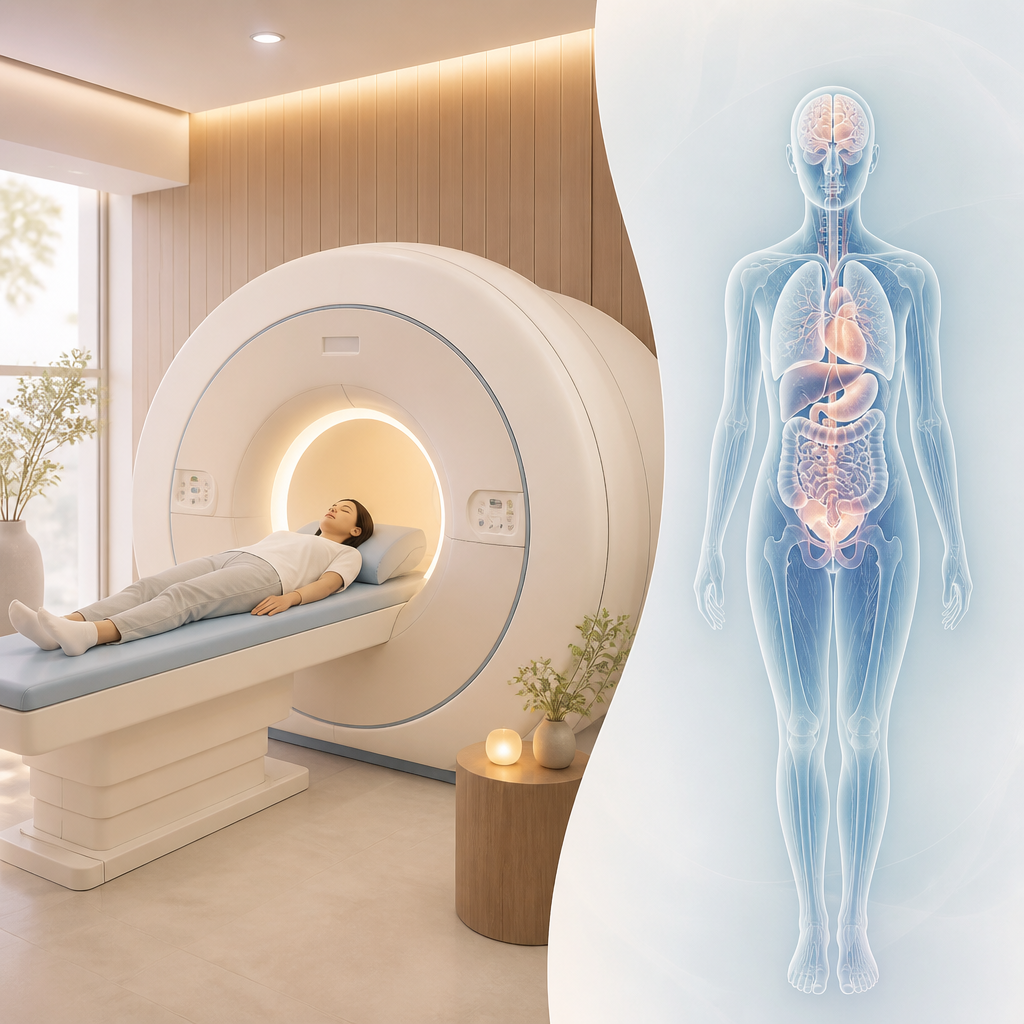
You will lie still inside a large, tube-shaped MRI scanner for 40 to 90 minutes. The machine uses strong magnets and radio waves to create detailed images of your organs and tissues without using ionizing radiation.
There is no physical recovery period. Most patients can return to work and normal activities immediately after the scan, though some may experience short-term anxiety while awaiting results.
Costs vary significantly based on the facility and whether it is part of a clinical trial or private preventive health package; insurance coverage is often limited for asymptomatic screening.
Questions to ask your doctor
- Is this screening recommended for my specific genetic risk profile?
- How does this facility handle incidental findings that may not be cancerous?
- Will a specialized radiologist review my entire set of images?
- What are the next steps if an abnormality is detected?
- Does this specific scan include a dedicated review of the brain and heart?
Frequently asked
No, unlike CT scans or X-rays, MRI technology uses magnetic fields and radio waves, meaning there is no exposure to ionizing radiation.
While highly sensitive, the prevalence yield for preventive screening is not yet completely clear, and it may not detect all cancer types or very small lesions.
Some patients experience short-term distress or anxiety during the procedure or while waiting for results, but research shows it is generally well-accepted in the long term.
Systematic reviews indicate WB-MRI is a valuable tool for cancer surveillance in individuals with germline TP53 mutations.
Deep dive: Whole-Body Cancer Screening MRI: 2026 Concierge Care Guide
Disclaimer: The information provided in this blog post is for educational purposes only and does not constitute medical advice, diagnosis, or treatment. Always seek the advice of your physician or another qualified health provider with any questions you may have regarding a medical condition.
As we move into 2026, the landscape of preventive medicine has shifted from reactive care—treating symptoms as they appear—to proactive precision. In the world of concierge medicine, the goal is no longer just to live longer, but to maintain a high "healthspan." One of the most powerful tools currently driving this revolution is the Whole-Body Cancer Screening MRI.
By utilizing advanced imaging technology paired with artificial intelligence, these scans offer a comprehensive look inside the body without the need for radiation. For those who value peace of mind and data-driven wellness, understanding the nuances of this screening is the first step toward a proactive health strategy.
Who it's for
Whole-body MRI (WBMRI) is not typically used for routine diagnostic work when a specific symptom is already present; rather, it is designed for asymptomatic individuals who want a baseline of their current health. In a concierge setting, this screening is most often sought by three specific groups.
First, individuals with a significant family history of cancer find these scans invaluable. While genetic testing can tell you your risk, an MRI can show you your current status. Second, it is a flagship service for the "worried well"—individuals who are highly proactive about their longevity and want to catch potential issues, such as tumors or metabolic changes, at Stage 0 or 1 when they are most treatable. Finally, high-performance executives and athletes use these scans as part of an annual "biohacking" or optimization protocol to ensure no silent inflammation or structural issues are hindering their performance.
It is important to note that this is a screening tool for adults. It is generally recommended for those aged 35 and older, as the statistical likelihood of finding clinically significant findings increases with age.
How it works
The technology behind a 2026-era whole-body MRI is a marvel of physics and software. Unlike a standard MRI, which might focus only on a knee or the lower back, a whole-body scan captures images from the top of the head to the mid-thighs (and sometimes lower).
The process uses powerful magnets and radio waves to create high-resolution, three-dimensional images of your organs, soft tissues, and skeletal system. In recent years, the integration of Artificial Intelligence (AI) has revolutionized this process. AI algorithms now assist radiologists by flagging "regions of interest" that might be too subtle for the human eye, comparing your results against a database of millions of images to identify anomalies in the liver, pancreas, kidneys, brain, and prostate.
A typical screening session lasts between 60 and 90 minutes. You will lie on a motorized table that slides into the bore of the MRI machine. Modern concierge suites often equip these machines with "cinema vision" goggles or high-fidelity audio systems, allowing you to watch a movie or listen to a podcast during the scan to help pass the time and alleviate any claustrophobia.
Recovery & timeline
One of the greatest benefits of an MRI screening is that it is entirely non-invasive. There are no needles (unless a specific contrast agent is requested, which is rare for general screenings), no recovery time, and no downtime. You can drive yourself to and from the appointment and resume your normal exercise or work schedule immediately.
The timeline for results is where the concierge experience shines. In a traditional hospital setting, you might wait weeks for a report. In a 2026 concierge practice, the timeline usually follows this path:
- Immediate Post-Scan: A preliminary review might be discussed to ensure image quality was sufficient.
- 48 to 72 Hours: A board-certified radiologist completes a "deep dive" read, often assisted by AI analysis.
- 7 Days: You meet with your primary concierge physician for a 60-minute "Health Optimization" consultation. During this meeting, you don't just get a PDF; you review the 3D renderings of your body together, discussing any findings within the context of your lifestyle, blood work, and genetic profile.
Cost & insurance
In 2026, Whole-Body MRI remains a premium service. Because it is categorized as a "screening" for asymptomatic individuals rather than "diagnostic" for a specific ailment, it is almost never covered by standard private insurance or Medicare.
The cost typically ranges from $2,500 to $5,000 per scan. While this is a significant out-of-pocket expense, many patients view it as an investment in "health insurance" for their future. Many concierge practices allow patients to use Health Savings Accounts (HSA) or Flexible Spending Accounts (FSA) to cover the cost, as it is a qualified medical expense when ordered by a physician.
When evaluating the cost, consider what is included. Some "budget" centers offer the scan only. A concierge-level price point usually includes the AI analysis, a private suite, a consult with a top-tier radiologist, and a follow-up plan with your personal physician.
Risks & alternatives
The primary "risk" of a Whole-Body MRI is not physical, but psychological and financial: the "incidentaloma." Because the scan is so sensitive, it will almost certainly find something—a benign cyst on the kidney, a tiny nodule on the lung, or a slight disc protrusion in the spine. These are often "incidental" findings that would never have caused a health problem. However, they can lead to "scanxiety" (anxiety caused by medical imaging) and may trigger a cascade of follow-up tests or biopsies that carry their own risks.
Physically, the scan is very safe because it uses no ionizing radiation, unlike CT scans or X-rays. The main contraindications are for those with certain metal implants, such as older pacemakers or shrapnel, though most modern medical implants are "MRI-conditional."
Alternatives to WBMRI include:
- Liquid Biopsies: High-sensitivity blood tests (like Galleri or similar multi-cancer early detection tests) that look for DNA shed by cancer cells.
- Focused Screening: Traditional mammograms, colonoscopies, and low-dose CT scans for smokers, which are often covered by insurance for specific age groups.
- Physical Exams: Comprehensive blood panels and physical palpation, though these lack the internal visibility of an MRI.
How to choose a provider
Not all MRI centers are created equal. When choosing a provider for a whole-body screening in 2026, you should look for three specific markers of quality.
First, ask about the "Tesla" (T) strength of the magnet. A 3T MRI is the current gold standard for clinical imaging, providing significantly higher resolution than the older 1.5T machines often found in general imaging centers.
Second, inquire about the radiology team. You want your scan read by a sub-specialized radiologist—someone who spends their life looking at whole-body preventive scans—rather than a generalist. Ask if they use AI-assisted detection to supplement the human eye.
Finally, consider the "Continuity of Care." A standalone imaging center will simply mail you a report and leave you to figure it out. A concierge provider will integrate the scan into your larger health plan. The value isn't just in the pictures; it’s in the professional guidance on what to do—or not do—based on those pictures.
If you are ready to take a proactive leap into the future of your health, contact our office today to book your comprehensive wellness consultation and determine if a whole-body MRI is the right next step for your longevity plan.
Sources
- Whole-body magnetic resonance imaging (WB-MRI) for cancer ...
- Whole‐body MRI for preventive health screening - PMC - NIH
- How to implement a radiologist led whole-body MRI screening ...
- Whole-Body MRI Screening for Carriers of Germline TP53 Mutations ...
- Whole-body magnetic resonance imaging (WB-MRI) for cancer ...
Find a board-certified concierge medicine provider in your area.
General information only — not medical advice. Always consult a qualified clinician for your specific situation.