Knee Replacement
Learn about total and partial knee replacement, including recovery timelines, longevity statistics, and what to expect during this common orthopedic procedure.
- Success rate
- 55% – 82%
- Avg cost (US)
- Contact Provider
- Recovery
- 42-84 days (range)
- US volume / yr
- Over 790,000 (range)
Browse verified orthopedic surgery providers who offer this procedure.
Knee replacement is designed for individuals with severe joint damage, often from arthritis, who experience chronic pain and limited mobility that has not improved with conservative treatments.
During the procedure, surgeons remove damaged bone and cartilage, replacing them with metal and plastic components. While traditional stays were common, many patients aged 50-89 can now safely be discharged home on the same day as surgery.
Recovery involves physical therapy to regain strength and movement. Partial knee surgery typically offers a faster recovery time—roughly half that of a total replacement—due to reduced surgical complexity and less postoperative pain.
Costs vary widely based on insurance, facility type, and surgical technique; consult your provider for specific U.S. pricing in 2026.
Questions to ask your doctor
- Am I a candidate for a partial knee replacement or total replacement?
- Is same-day discharge a safe option for my specific health profile?
- What is the expected lifespan of the implant being used?
- What specific physical therapy milestones should I aim for in the first month?
- How does your surgical volume affect my predicted outcome and complication risk?
Frequently asked
Data shows that 82% of total knee replacements and 72% of partial (unicompartmental) replacements last more than 25 years.
Research indicates similar recovery rates for patients between ages 50 and 89, suggesting older adults can often return home safely on the day of surgery.
If a replacement needs to be redone (revision), success rates are approximately 55%, though more aggressive treatments may be required for late-stage issues.
Deep dive: Knee Replacement in 2026: Modern Recovery & Robotic Surgery
Medical Disclaimer: This information is for educational purposes only and does not constitute medical advice. Always consult with a qualified healthcare professional regarding any medical condition or treatment.
Who it's for
Knee replacement surgery, also known as knee arthroplasty, is primarily designed for individuals suffering from severe joint damage that interferes with daily life. By 2026, the criteria for who can receive a knee replacement have expanded thanks to better materials and less invasive techniques, but the core goal remains the same: relieving chronic pain and restoring mobility.
Most candidates for this procedure have advanced osteoarthritis, which is the "wear and tear" that erodes the cartilage cushioning the knee. You might also be a candidate if you have rheumatoid arthritis or significant joint damage following an injury.
How do you know it’s time? It is generally for people who experience:
- Severe knee pain or stiffness that prevents you from walking, climbing stairs, or getting in and out of chairs.
- Moderate-to-severe pain while resting, which may interfere with sleep.
- Chronic knee inflammation and swelling that does not improve with rest or medications.
- A knee deformity, such as a bowing in or out of the joint.
- A failure to find relief from non-surgical treatments like physical therapy, cortisone injections, or anti-inflammatory drugs.
While historically reserved for older adults, the durability of modern implants means more patients in their 40s and 50s are successfully undergoing the procedure to maintain an active lifestyle.
How it works
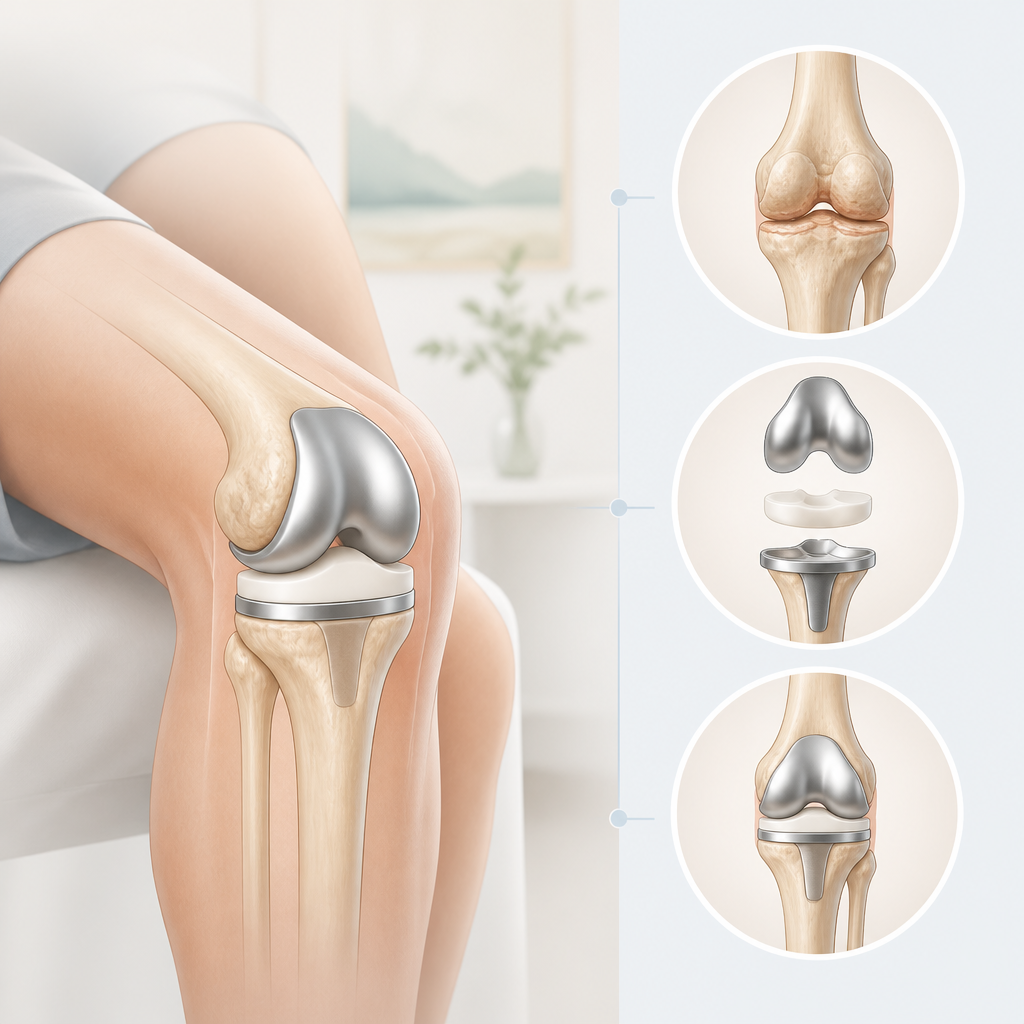
The "replacement" of a knee joint is actually more of a "resurfacing." Your surgeon does not remove the entire knee; instead, they remove the damaged surfaces at the ends of the thigh bone (femur) and shin bone (tibia).
In 2026, the procedure is increasingly guided by sophisticated technology. Many surgeons now use robotic-assisted systems and 3D preoperative modeling. This allows the surgeon to map your unique anatomy with sub-millimeter precision before the first incision is ever made. During the procedure:
- Preparation: The surgeon removes the damaged cartilage and a small amount of underlying bone to create a clean surface.
- Positioning the Implants: Metal components are cemented or "press-fit" into the bone. These components recreate the surface of the joint.
- Resurfacing the Kneecap: If necessary, the underside of the kneecap (patella) is resurfaced with a durable plastic button.
- Inserting a Spacer: A medical-grade plastic (polyethylene) spacer is inserted between the metal components. This creates a smooth gliding surface, mimicking the function of natural cartilage.
Modern implants are made of biocompatible materials like cobalt-chromium or titanium alloys, which are designed to last 20 to 25 years or more with proper care.
Recovery & timeline
One of the biggest advancements in recent years is the shift toward "Enhanced Recovery After Surgery" (ERAS) protocols. Many knee replacements in 2026 are performed as outpatient procedures, meaning you may go home the same day.
- Days 1–2: Movement starts immediately. You will likely be encouraged to stand and walk with a walker or cane within hours of surgery. This prevents blood clots and helps the new joint settle.
- Weeks 1–3: You will focus on wound healing and regaining basic motion. Physical therapy (PT) usually happens 2–3 times a week. You will practice walking, sitting, and basic leg lifts.
- Weeks 4–6: Most patients can resume driving once they are off narcotic pain medications and have regained sufficient strength and reaction time. You may transition from a walker to a cane or walk unassisted.
- Months 3–6: This is the "strengthening phase." You will return to low-impact activities like swimming, cycling, or golfing. Most of the swelling should be gone, though some warmth in the joint is normal.
- One Year: Total recovery is usually achieved by the one-year mark. By this point, the replacement should feel natural, and you can enjoy the full range of your improved mobility.
Cost & insurance
The cost of a knee replacement varies significantly based on your location, the facility, and the specific technology used (such as robotic assistance). On average, the total cost can range from $15,000 to $40,000.
In 2026, most major insurance providers, including Medicare, cover knee replacement surgery if it is deemed "medically necessary"—meaning you have tried conservative treatments like PT and weight loss without success.
Things to consider for your budget:
- Pre-surgery: Consultations, MRIs, and "Pre-hab" physical therapy.
- The Procedure: Surgeon’s fees, anesthesiology, and hospital/surgical center facility fees.
- Post-surgery: Home health care, outpatient physical therapy, and any specialized equipment (like a cold-compression machine).
Always call your insurance provider beforehand to confirm "In-Network" status for both your surgeon and the surgical facility. Many insurance plans now offer "bundled payments," which provide one flat rate for the entire episode of care, from surgery through 90 days of recovery.
Risks & alternatives
Like any major surgery, a knee replacement carries risks. These include infection, blood clots (deep vein thrombosis), and implant failure or loosening over time. Nerve damage or stubborn stiffness (arthrofibrosis) can also occur. However, complication rates remain low, typically under 1-2%.
Before committing to surgery, your doctor will likely explore alternatives:
- Injections: Hyaluronic acid (gel) injections or "biologics" like PRP (platelet-rich plasma) can sometimes delay the need for surgery.
- Weight Management: Shedding even a few pounds can significantly reduce the pressure on your knee joints.
- Physical Therapy: Strengthening the muscles around the knee (the quads and hamstrings) can provide better support for the joint.
- Partial Knee Replacement: If only one "compartment" of your knee is damaged, you may be a candidate for a less invasive partial replacement.
How to choose a provider
Selecting the right surgeon is the most important factor in your outcome. In 2026, patients have more data than ever to help make this choice.
Look for these key indicators:
- Volume: Research shows that surgeons who perform a high volume of knee replacements (at least 50–100 per year) typically have lower complication rates.
- Technology Integration: Ask the surgeon if they use robotic assistance or customized 3D cutting blocks, and why they choose those tools for your specific case.
- Specialization: Look for an orthopedic surgeon who is fellowship-trained specifically in "Adult Reconstructive Surgery."
- The Care Team: A great surgeon is backed by a great team. Ensure the practice has dedicated physical therapists and coordinators who will guide you from the day of your consultation through your final PT session.
- Patient Outcomes: Don't be afraid to ask for the practice's "readmission rate" or "infection rate." Quality providers track these numbers and are transparent about them.
Trust your gut during the consultation. You want a surgeon who explains the procedure clearly, listens to your goals, and doesn't rush you toward surgery if you aren't ready.
If you are ready to reclaim your mobility and live without chronic knee pain, contact our office today to book a comprehensive orthopedic consultation.
Related patient questions
- Robotic vs traditional knee replacement?
- How long does knee replacement surgery take?
- How long is recovery from total knee replacement?
- How much does knee replacement cost?
- How long does a knee replacement last?
- What are the risks of knee replacement?
- How long does knee replacement surgery take?
- How long is recovery from total knee replacement?
Sources
- Clinical and Economic Burden of Revision Knee Arthroplasty - PMC
- How long do revised and multiply revised knee replacements last ...
- Similar Recovery Rate for Patients Aged between 50 and 89 Years ...
- Partial knee replacement benefits eligible patients - Mayo Clinic
- Total Knee Arthroplasty Techniques - StatPearls - NCBI Bookshelf
Find a board-certified orthopedic surgery provider in your area.
Related procedures
General information only — not medical advice. Always consult a qualified clinician for your specific situation.