ACL Surgery
ACL surgery repairs torn knee ligaments to restore stability. Learn about procedure success rates, recovery timelines, and costs for this common orthopedic…
- Success rate
- Up to 97%
- Avg cost (US)
- $10,000-$25,000 (range)
- Recovery
- 232 days
- US volume / yr
- 100,000-300,000 (range)
Browse verified orthopedic surgery providers who offer this procedure.
This procedure is designed for individuals with a torn anterior cruciate ligament (ACL) who experience knee instability, especially athletes or active people looking to return to sports and physical activities.
Usually performed as an outpatient procedure using knee arthroscopy, surgeons replace the torn ligament with a graft. Patients typically begin seeing improvements in knee utility approximately 12 weeks after surgery.
Initial recovery involves physical therapy to regain motion. Athletes often pass return-to-sport criteria around 232 days (roughly 7.5 months) post-surgery, with most returning to sports within one year.
While individual costs vary by provider and insurance, choosing reconstruction early can lead to a lifetime cost reduction of $4,503 compared to non-surgical rehabilitation alone.
Questions to ask your doctor
- What type of graft (autograft or allograft) is best for my activity level?
- What are the specific return-to-sport criteria I must meet?
- What is the risk of a secondary tear in my other knee?
- When can I expect to return to my pre-injury level of play?
- How will physical therapy be scheduled during the first 12 weeks?
Frequently asked
Approximately 95% of patients return to sports within one year, with 78% returning to their pre-injury level of performance.
Data shows that within 6 years, about 18.9% of patients may require a follow-up procedure on the same knee.
Yes, research indicates that ACL reconstruction is more cost-effective over a lifetime and provides higher quality-of-life gains than non-surgical options.
Deep dive: ACL Surgery in 2026: Recovery Timeline & New Tech Guide
Disclaimer: This article is for informational purposes only and does not constitute medical advice. Please consult with a qualified healthcare professional for clinical diagnosis and treatment options.
Who it’s for
The Anterior Cruciate Ligament (ACL) is one of the major stabilizing ligaments in your knee. In 2026, ACL injuries remain one of the most common orthopedic challenges, particularly for those leading active lifestyles. While we often associate this injury with professional athletes, the majority of patients seeking surgery are "weekend warriors," student-athletes, and individuals who have experienced a sudden twist or fall during everyday activities.
Surgery is typically recommended for individuals who experience "knee instability"—that feeling of the knee "giving out" during pivoting or lateral movements. If you are an athlete in a cutting sport (like soccer, basketball, or skiing), surgery is often the gold standard to return to your previous level of performance. However, surgery is also for non-athletes who find that their knee instability interferes with their job, their ability to climb stairs, or their desire to remain active as they age.
In recent years, we have seen a rise in "pediatric" ACL reconstructions for younger children, as well as "master" reconstructions for patients in their 60s and 70s who remain highly active. If your MRI shows a high-grade tear and you have a desire to return to activities involving pivoting or jumping, you are likely a candidate for this procedure.
How it works
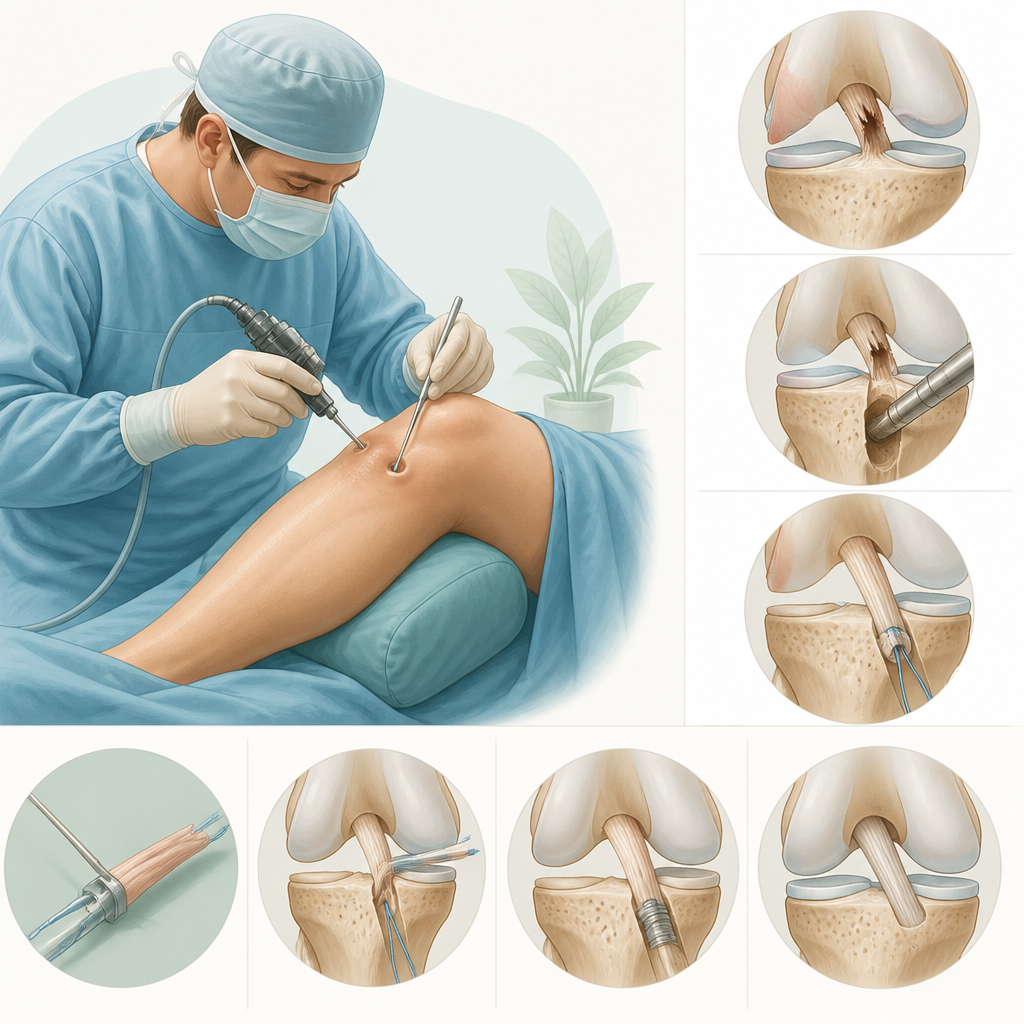
ACL surgery has evolved significantly over the last decade. It is almost always performed arthroscopically, using "keyhole" incisions that allow the surgeon to work inside the joint with a tiny camera and specialized instruments. Unlike a simple "repair" where the ends are stitched back together (which is only possible in very specific types of tears), most ACL surgeries are "reconstructions." This means the damaged ligament is replaced with a new tissue graft.
In 2026, the choice of graft is more personalized than ever. Your surgeon will discuss three main options:
- Autograft: This uses your own tissue, typically from the patellar tendon, hamstring, or quadriceps tendon. Quadriceps grafts have gained significant popularity recently due to their strength and lower rates of site pain.
- Allograft: This uses donor tissue from a cadaver. This is often preferred for older patients or those undergoing revision surgery, as it involves less immediate post-operative pain and a smaller surgical footprint.
- Bridge-Enhanced ACL Restoration (BEAR): This newer technique uses a specialized collagen implant to help your body heal its own native ligament, rather than replacing it entirely.
Once the graft is selected, the surgeon creates tunnels in the femur (thigh bone) and tibia (shin bone) to pull the graft into the correct anatomical position. It is then secured with specialized screws or anchors that eventually integrate into your bone.
Recovery & timeline
Recovery from ACL surgery is a marathon, not a sprint. While modern techniques have made the immediate post-operative period more comfortable, the biological timeline for a graft to become a living ligament cannot be rushed.
- Phase 1 (Weeks 1-2): The goal is "quieting" the knee. You will focus on reducing swelling, regaining full extension (straightening the leg), and getting the quadriceps muscle to "wake up." Many patients use a motorized cold-therapy wrap and crutches during this time.
- Phase 2 (Weeks 3-8): This is the "functional" phase. You will likely transition off crutches and focus on walking with a normal gait. You’ll begin stationary cycling and closed-chain strengthening exercises.
- Phase 3 (Months 3-6): This is often the hardest phase mentally. Your knee feels "good," but the graft is actually at its weakest point biologically as it undergoes "ligamentization." You will begin jogging and more intensive weight training under strict supervision.
- Phase 4 (Months 7-12): This is the "return to sport" phase. In 2026, most surgeons require a battery of "Functional Move Testing" (FMT) before clearing an athlete. This ensures your surgical leg is within 90% of the strength of your healthy leg. Full clearance for high-impact sports typically occurs between 9 and 12 months.
Cost & insurance
The cost of ACL surgery in 2026 varies based on your geographic location, the facility (hospital vs. outpatient surgery center), and the type of graft used. On average, the total cost for the procedure, anesthesia, and facility fees ranges from $8,000 to $20,000.
Most major insurance providers cover ACL reconstruction because it is considered "medically necessary" to restore stability and prevent future joint decay. However, patient responsibility—deductibles and co-insurance—can vary widely.
When budgeting, it is essential to look beyond the surgery itself. You must account for:
- Pre-operative "pre-hab" physical therapy.
- Post-operative physical therapy (2-3 times a week for several months).
- The cost of a functional knee brace, if required by your surgeon.
- Durable medical equipment like crutches or cold-therapy units.
Always request a "good faith estimate" from your provider's billing office and confirm that your surgeon and the surgical facility are both in-network for your specific plan.
Risks & alternatives
Like any surgery, ACL reconstruction carries risks. These include infection, blood clots (DVT), graft failure (re-tear), and persistent knee stiffness. There is also a risk of developing early-onset osteoarthritis in the injured knee, though surgery aims to stabilize the joint to mitigate this risk.
It is important to know that surgery is not the only path. For "low-demand" patients—those who do not participate in pivoting sports or have physically demanding jobs—non-operative management can be successful. This involves a dedicated physical therapy program to strengthen the surrounding muscles (quads, hamstrings, and glutes) to compensate for the missing ligament.
Advancements in "biological" treatments, such as Platelet-Rich Plasma (PRP) or stem cell injections, are often discussed. While these can help with inflammation and partial tears, they generally cannot "regrow" a fully ruptured ACL. If you choose the non-operative route, you must accept that you may have a higher risk of secondary injuries, such as meniscus tears, if the knee gives out during activity.
How to choose a provider
Choosing the right surgeon is the most critical factor in your long-term success. In 2026, technology allows patients to be more informed than ever before. When evaluating a provider, consider the following:
- Sub-specialization: Look for an orthopedic surgeon who is fellowship-trained in Sports Medicine. These specialists perform ACL reconstructions weekly, if not daily.
- Volume and Outcomes: Don’t be afraid to ask how many ACL reconstructions they perform annually and what their "revision rate" (the rate at which their surgeries need to be redone) is.
- The Care Team: Successful recovery depends heavily on your physical therapist. Ask if the surgeon has a dedicated protocols or works closely with specific therapists who specialize in ACL rehabilitation.
- Technology Integration: Ask if they use computer-assisted navigation or robotic assistance, which can help in precise tunnel placement, or if they offer the latest graft options like the BEAR implant.
Ultimately, you want a surgeon who listens to your specific goals—whether that is returning to the professional soccer pitch or simply being able to hike with your grandchildren without fear.
If you are ready to regain stability and get back to the activities you love, contact our office today to book a comprehensive orthopedic consultation.
Related patient questions
- How long does knee replacement surgery take?
- How long is recovery from ACL surgery?
- How much does ACL reconstruction cost?
- Do I need ACL surgery, or can I recover without it?
- What is the success rate of rotator cuff repair?
- How long is recovery from ACL surgery?
- Do I need ACL surgery, or can I recover without it?
- What is the success rate of rotator cuff repair?
Sources
- Failure of Anterior Cruciate Ligament Reconstruction - PMC - NIH
- Societal and Economic Impact of Anterior Cruciate Ligament Tears
- TWO YEAR ACL REINJURY RATE OF 2.5%: OUTCOMES REPORT ...
- The Rate of Subsequent Surgery and Predictors Following ACL ...
- Cost-Effectiveness Analysis of Early Reconstruction versus ... - PMC
Find a board-certified orthopedic surgery provider in your area.
Related procedures
General information only — not medical advice. Always consult a qualified clinician for your specific situation.