Rotator Cuff Repair
Rotator cuff repair is a common surgery to reattach torn shoulder tendons. Learn about healing rates, recovery timelines, and what to expect during your…
- Success rate
- 16%–94% (range)
- Avg cost (US)
- $15,000–$35,000 (range)
- Recovery
- 180–365 days
- US volume / yr
- ~460,000/yr (range)
Browse verified orthopedic surgery providers who offer this procedure.
This procedure is for individuals with shoulder pain or weakness caused by a torn rotator cuff. It is typically recommended when non-operative treatments—which have a satisfactory outcome rate of approximately 62% to 74%—do not provide sufficient relief.
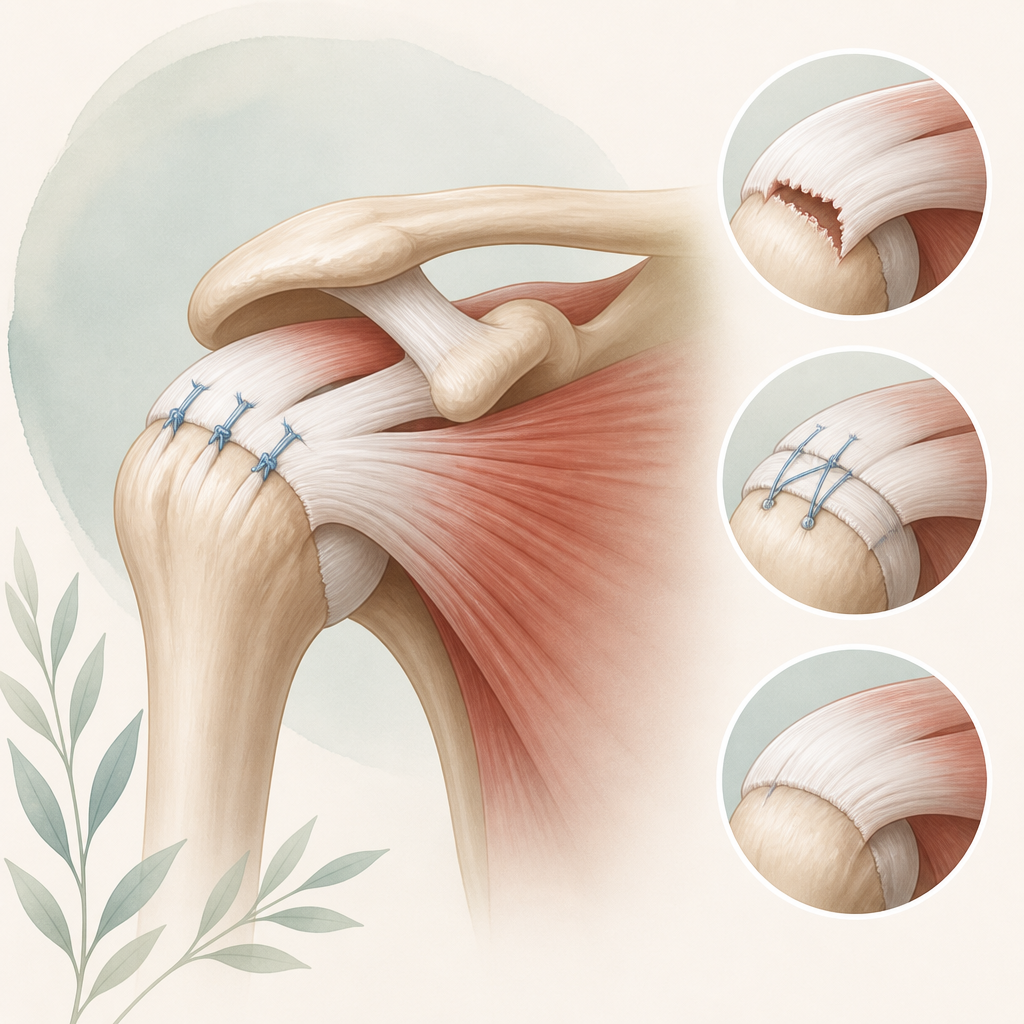
The surgery involves reattaching the tendon to the humerus bone, often using arthroscopic techniques. While clinical outcomes and pain relief are often positive, structural healing of the tendon depends heavily on the initial size of the tear and the patient's age.
Healing is a long-term process, with failure rates measured at the 12-month mark. Rehabilitation involves immobilization in a sling followed by physical therapy to restore strength. Many patients report satisfactory clinical results even if the tendon does not fully heal.
Costs vary based on insurance coverage, facility fees, and the complexity of the tear. Patients should consult their provider for estimated out-of-pocket expenses for the surgery and subsequent physical therapy.
Questions to ask your doctor
- How large is my tear and how does that affect my specific healing probability?
- What are the risks of a re-tear given my age and activity level?
- How long will I need to wear a sling after the procedure?
- What is the physical therapy schedule for the first six months?
- If the tendon fails to heal structurally, what does that mean for my shoulder function?
Frequently asked
Healing rates vary significantly; research shows rates as high as 91% for small tears but as low as 6% for large or massive tears.
Yes. Studies show that re-tear rates range from 13% to 94%, yet many patients still report satisfactory clinical outcomes and improved function.
Increasing age is a known factor that can reduce the rate of tendon-to-bone healing post-surgery.
Deep dive: Rotator Cuff Repair 2026: Recovery, Costs & New Techniques
Medical Disclaimer: The information in this blog post is for educational purposes only and does not constitute medical advice. Please consult with a qualified healthcare professional for a diagnosis and treatment plan tailored to your specific needs.
Who it's for
The rotator cuff is a group of four muscles and tendons that wrap around the shoulder joint, acting like a sleeve to keep your arm bone securely in the socket. When these tendons are torn—either through a sudden injury or years of wear and tear—daily life can become exhausting.
In 2026, rotator cuff repair is primarily recommended for individuals who have failed to find relief through physical therapy and injections. You might be an ideal candidate if:
- You have persistent nighttime pain: One of the hallmark signs of a rotator cuff tear is an aching pain that prevents you from sleeping, especially when lying on the affected side.
- You experience functional weakness: If you struggle to lift a gallon of milk, reach into a high cabinet, or brush your hair, the mechanical integrity of the shoulder may be compromised.
- You have an acute injury: While many tears are degenerative, sudden tears caused by a fall or heavy lifting often require prompt surgical intervention to prevent the muscle from "retracting" or shrinking.
- You are active or lifting-dependent: Athletes and manual laborers often opt for surgery to regain the high-level strength required for their activities.
Improvements in diagnostic imaging now allow surgeons to see not just the tear, but the quality of the muscle itself, helping us determine who will benefit most from surgery versus conservative management.
How it works
Modern rotator cuff repair has evolved significantly, moving away from large, open incisions toward minimally invasive techniques. In 2026, the standard of care is arthroscopic repair.
During this procedure, the surgeon makes several small incisions (about the size of a buttonhole) around the shoulder. A tiny camera called an arthroscope is inserted, allowing the surgeon to view the joint on a high-definition monitor. Using specialized micro-instruments, the surgeon clears away damaged tissue and reattaches the torn tendon to the bone using "suture anchors." These anchors are tiny devices that stay in the bone permanently and hold the tendon in place while it heals.
Newer biological enhancements are also becoming common. Surgeons may now use "biologic patches" or "collagen scaffolds" to reinforce the repair, especially for patients with poor tissue quality. These materials act as a trellis, encouraging your body’s own cells to grow into the repair site, potentially reducing the risk of a re-tear. The entire procedure usually takes 60 to 90 minutes and is typically performed on an outpatient basis.
Recovery & timeline
Recovery from shoulder surgery is a marathon, not a sprint. Because we are waiting for a tendon to knit itself back into the bone, the timeline is dictated by biology rather than just how you feel.
- Weeks 0–6 (Protection Phase): You will spend most of this time in a specialized sling or immobilizer. The goal is to keep the shoulder still so the repair isn't disrupted. You will likely begin "passive" range of motion, where a therapist or a machine moves your arm for you.
- Weeks 6–12 (Active Motion): The sling comes off. You will begin moving the arm under your own power, but without lifting any weight. The focus here is on regaining flexibility.
- Months 3–6 (Strengthening): Once the tendon is firmly attached, you will begin resistance training to rebuild the muscles that have likely weakened due to disuse.
- Months 6–9 (Return to Sport/Work): Most patients return to full activity, including overhead sports or heavy lifting, around the nine-month mark.
By 2026, many physical therapy programs have moved to "hybrid" models, combining in-person visits with wearable sensors that track your home exercises and send the data directly to your surgeon.
Cost & insurance
The cost of rotator cuff repair varies based on your location, the facility (hospital vs. surgery center), and the complexity of the tear. On average, the total cost for the procedure, anesthesia, and facility fees ranges from $8,000 to $20,000.
In 2026, most major insurance carriers, including Medicare, cover rotator cuff repair when it is deemed "medically necessary"—meaning you have documented proof of a tear (via MRI) and have tried conservative treatments like physical therapy for at least six to twelve weeks.
It is important to look into your specific plan’s out-of-pocket maximum and deductible. Many patients now utilize "bundled payment" models where the surgery, anesthesia, and initial physical therapy are all covered under one flat fee, providing more transparency and fewer surprise bills.
Risks & alternatives
No surgery is without risk. For rotator cuff repair, the primary risks include:
- Stiffness (Frozen Shoulder): The most common complication, where the joint becomes tight. This usually resolves with therapy.
- Re-tear: The tendon may fail to heal to the bone, particularly in patients who smoke or have poorly controlled diabetes.
- Nerve injury or infection: These are rare but possible in any surgical procedure.
Alternatives to surgery include:
- Physical Therapy: Strengthening the surrounding "compensator" muscles to take the load off the torn tendon.
- Cortisones or Hyaluronic Acid: Injections to manage pain, though they do not fix the tear.
- Biologic Injections (PRP/Cell-based therapies): While increasingly popular in 2026, these are often used for partial tears or as an adjunct to surgery, rather than a standalone replacement for a full-thickness repair.
How to choose a provider
Your outcome depends heavily on the technical skill of your surgeon and the quality of your post-operative support. When choosing a provider, consider the following:
- Specialization: Look for an orthopedic surgeon who is fellowship-trained in Sports Medicine or Shoulder and Elbow surgery. You want someone who performs these repairs weekly, not just a few times a year.
- Technological Integration: Ask if they use advanced imaging or biological reinforcements. A surgeon who stays current with 2026 standards will have a clear protocol for complex tears.
- The Care Team: Surgery is only half the battle. Ensure the office has a dedicated coordination team and works closely with specialized physical therapists.
- Transparency: A good surgeon will be honest about your "healing potential." If you have a massive, chronic tear, they should discuss the possibility of a "superior capsular reconstruction" or a "reverse shoulder replacement" instead of a standard repair.
Don’t be afraid to ask about their specific re-tear rates and how they handle post-operative pain management. A modern practice should prioritize non-opioid pain protocols to keep you comfortable and safe during the first week home.
If shoulder pain is keeping you from the activities you love or waking you up at night, contact our office today to schedule a comprehensive evaluation and discuss your treatment options.
Related patient questions
- How long is recovery from rotator cuff repair?
- How much does rotator cuff surgery cost?
- Do all rotator cuff tears need surgery?
- What is the success rate of rotator cuff repair?
- How long is recovery from rotator cuff repair?
- How much does rotator cuff surgery cost?
- Do all rotator cuff tears need surgery?
- What is the success rate of rotator cuff repair?
Sources
- Factors affecting healing after arthroscopic rotator cuff repair - PMC
- Risk Factors for Rotator Cuff Repair Failure and Reliability of the ...
- Increasing age and tear size reduce rotator cuff repair healing rate at ...
- The Societal and Economic Value of Rotator Cuff Repair - PMC - NIH
- Re-tears after rotator cuff repair: Current concepts review - PMC
Find a board-certified orthopedic surgery provider in your area.
Related procedures
General information only — not medical advice. Always consult a qualified clinician for your specific situation.